
iptv-for-android
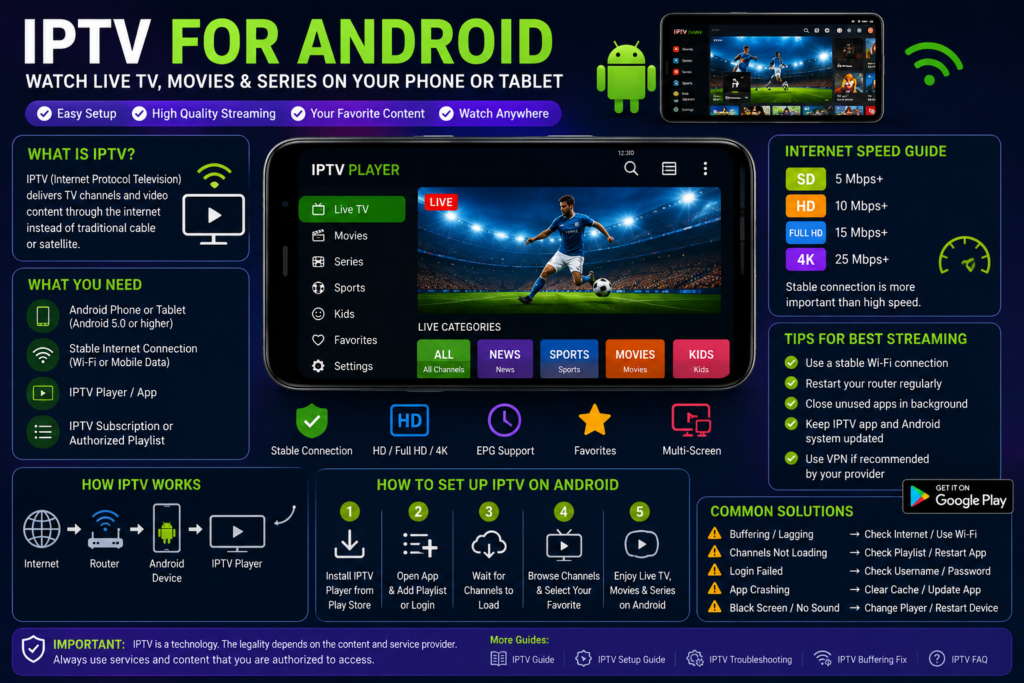
IPTV for Android: Complete Setup Guide 2026
IPTV for Android gives you a convenient way to watch internet-delivered television and video content on compatible Android phones and tablets. With a reliable internet connection, a suitable IPTV player, and an authorized IPTV service, you can access supported live channels and other streaming content from your Android device.
This guide explains how IPTV works on Android, what you need before getting started, how to install and configure a compatible IPTV player, and how to troubleshoot common problems such as buffering, loading, login errors, and playback issues.
Important: IPTV is a technology for delivering video over an internet connection. Always use IPTV services and content that you are authorized to access.
What Is IPTV for Android?
IPTV stands for Internet Protocol Television. It is a method of delivering television and video content through an internet or IP network rather than traditional broadcast, cable, or satellite delivery.
On an Android phone or tablet, an IPTV player can connect to an authorized IPTV account, playlist, or supported streaming source and display the available content.
The exact setup depends on your Android version, device manufacturer, IPTV application, and service.
What Do You Need for IPTV on Android?
Before getting started, you normally need:
- An Android phone or tablet
- A reliable Wi-Fi or mobile data connection
- An IPTV-compatible player
- An authorized IPTV account, playlist, or connection information
- Enough available storage for the application
- A compatible Android version
For a better viewing experience, a larger Android tablet can be more comfortable for watching television for longer periods.
How Does IPTV Work on Android?
The basic process is:
Internet → Android device → IPTV player → Authorized IPTV service → Video playback
Your Android device connects to the internet and runs an IPTV-compatible application. The application connects to your authorized service or playlist and displays the available channels or video content.
Streaming performance depends on your internet connection, network stability, device performance, application, video quality, and service availability.
Which Android Devices Can Use IPTV?
IPTV applications can work on many Android devices, including:
- Android smartphones
- Android tablets
- Android TV devices
- Android TV boxes
- Some Android-based smart displays
- Other compatible Android devices
Application compatibility can vary depending on the Android version, hardware, screen size, and application requirements.
Always check the application’s current compatibility before installing it.
Internet Speed Requirements for IPTV on Android
The bandwidth required depends on video resolution and the stability of your connection.
As a general guideline:
| Video Quality | Suggested Stable Speed |
|---|---|
| SD | 5 Mbps or more |
| HD | 10 Mbps or more |
| Full HD | 15 Mbps or more |
| 4K | 25 Mbps or more |
These figures are general recommendations.
Your actual experience can vary depending on network congestion, Wi-Fi signal strength, mobile network conditions, device performance, and the number of devices using the connection.
Wi-Fi vs Mobile Data for IPTV
Android devices give you the option of using Wi-Fi or mobile data.
Wi-Fi
Wi-Fi is usually the better choice for regular IPTV streaming at home.
Advantages include:
- No mobile data usage
- Usually more suitable for extended streaming
- Can provide high bandwidth
- Good option for HD and higher-resolution video
For the best results, stay within a good range of your router and avoid heavily congested wireless networks.
Mobile Data
Mobile data can be useful when you are away from home.
However, streaming video can use a significant amount of mobile data, particularly at higher resolutions.
If your mobile plan has a data limit, check your data usage before watching IPTV for long periods.
How to Choose an IPTV Player for Android
There are many media and IPTV applications available for Android.
When choosing a player, consider:
- Android compatibility
- Application reliability
- Ease of use
- Playlist support
- EPG support
- Favorites
- Search functionality
- Playback controls
- Regular updates
- Developer reputation
- Privacy and permissions
Choose an application from a trusted source and review its permissions before installation.
How to Install an IPTV Player on Android
The simplest approach is to use a compatible application available through the official Google Play Store or another trusted source.
Step 1: Open Google Play Store
Open the Play Store on your Android phone or tablet.
Step 2: Search for a Compatible IPTV Player
Search for an IPTV player that supports your Android device and the connection method provided by your authorized service.
Step 3: Check the Application
Review the application information, compatibility, developer details, permissions, and user feedback.
Step 4: Install the Application
Select the application and install it.
Step 5: Open the IPTV Player
Launch the application after installation.
You can then configure it using the connection information supplied by your authorized IPTV provider.
How to Add IPTV Information on Android
The exact configuration depends on the IPTV player.
Some players may support:
- Username and password
- Playlist URLs
- M3U playlists
- Other supported connection methods
The general process is:
- Open the IPTV application.
- Select the option to add a playlist or account.
- Choose the appropriate connection method.
- Enter your authorized information.
- Save the configuration.
- Allow the application to load the available content.
- Test playback.
Never publish your personal IPTV username, password, playlist URL, or other private account information.
How to Load IPTV Channels on Android
After your account or playlist has been configured, the application may load the available categories automatically.
Depending on the player, you may see:
- Live TV
- Sports
- Movies
- Series
- Favorites
- Recently watched
- TV Guide
- Search
The available content depends on the IPTV service and your authorized account.
If the content does not load, check your internet connection and configuration details first.
How to Watch IPTV on an Android Phone
Watching IPTV on an Android phone is straightforward once the player is configured.
- Open your IPTV application.
- Select Live TV or another available category.
- Browse the available content.
- Select a channel or program.
- Wait for playback to begin.
- Use the player controls to pause, resume, or change content.
Landscape mode can provide a larger viewing area on many phones.
How to Watch IPTV on an Android Tablet
Android tablets can provide a larger screen than smartphones and can be useful for watching IPTV at home or while travelling.
The setup process is the same:
- Install a compatible IPTV player.
- Configure your authorized account or playlist.
- Allow the content to load.
- Select a channel or program.
- Use landscape mode when preferred.
A tablet can also be useful when several people want to watch content without using the main television.
How to Improve IPTV Streaming on Android
If IPTV playback is not smooth, try these steps.
Use a Stable Wi-Fi Connection
Stay close enough to your router to maintain a strong wireless signal.
Restart Your Router
Restarting the router can resolve temporary network problems.
Restart Your Android Device
A restart can clear temporary application or network issues.
Close Unnecessary Applications
Applications running in the background can use memory, processor resources, or network bandwidth.
Closing applications you are not using can help on devices with limited resources.
Check Your Internet Speed
Run a speed test and compare your result with the general requirements for the video quality you are watching.
Update Android
Keep your device’s operating system updated when updates are available and appropriate for your device.
Update Your IPTV Player
Use the latest compatible version of your IPTV application.
Reduce Video Quality
If high-resolution streams constantly buffer, test a lower resolution to determine whether available bandwidth is the problem.
IPTV Buffering on Android
Buffering happens when the device cannot receive enough video data quickly enough to maintain continuous playback.
Common causes include:
- Weak Wi-Fi
- Unstable mobile data
- Network congestion
- Slow internet
- Device performance limitations
- Application problems
- High video resolution
- Temporary service-side problems
Start by checking your internet connection and testing another channel.
For more detailed solutions, see our IPTV Buffering Fix guide.
Common IPTV Problems on Android
IPTV Channels Keep Loading
If a channel keeps loading without starting:
- Check your internet connection.
- Restart the IPTV application.
- Restart your Android device.
- Test another channel.
- Check your account or playlist information.
- Try a lower video quality if available.
If only one channel is affected, the problem may be specific to that stream.
IPTV Login Is Not Working
Verify that your username, password, playlist URL, or other connection information is correct.
Also check whether your authorized account is still active.
IPTV App Is Not Opening
Try:
- Closing the application.
- Restarting Android.
- Checking for an application update.
- Checking available storage.
- Clearing the application’s cache.
- Reinstalling the application if necessary.
IPTV App Keeps Crashing
An application can crash because of outdated software, limited memory, insufficient storage, compatibility problems, or application bugs.
Update the application and Android system where appropriate, then restart the device.
IPTV Has Sound but No Picture
Try another channel first.
If other channels work, the issue may be specific to the original stream.
If all content has the same problem, restart the application and check for updates.
IPTV Shows a Black Screen
A black screen can be caused by the application, stream, device, or compatibility settings.
Try another channel, restart the application, and check whether the problem occurs across different content.
How to Clear IPTV App Cache on Android
If your IPTV application becomes slow or unstable, clearing its cache may help.
The general Android process is:
- Open Android Settings.
- Go to Apps.
- Find your IPTV player.
- Open the application information page.
- Select Storage or Storage & Cache.
- Select Clear Cache.
- Open the application again.
Menu names can vary between Samsung, Xiaomi, Google Pixel, OnePlus, and other Android devices.
Be careful when selecting Clear Storage or Clear Data, because this may remove saved application settings or account information.
Android Storage and IPTV Performance
Your device should have enough free storage for normal operation.
If storage is almost full:
- Remove applications you no longer use.
- Delete unnecessary downloads.
- Clear temporary application caches.
- Remove old videos and files.
- Restart the device.
Keeping sufficient free storage can help Android applications operate normally.
Battery Usage When Watching IPTV
Video streaming can consume more battery than many ordinary applications.
To reduce battery usage:
- Lower screen brightness
- Use Wi-Fi when practical
- Close unnecessary background applications
- Avoid keeping the screen brighter than necessary
- Keep your Android device properly ventilated
For long viewing sessions, connecting the device to a charger may be useful.
Mobile Data Usage for IPTV
Streaming video can consume a significant amount of mobile data.
Higher video quality generally uses more data.
If you are using mobile data:
- Check your data allowance
- Prefer Wi-Fi when available
- Reduce video quality if necessary
- Monitor your monthly data usage
- Avoid leaving streams playing when you are not watching
Can Android IPTV Work in 4K?
Some Android devices can support 4K video, but this depends on the device hardware, application, stream, display, and internet connection.
A smartphone may support high-resolution video but still have a smaller display that does not provide the same viewing experience as a television.
For 4K streaming, all parts of the setup need to support the required resolution.
Can You Use IPTV on Multiple Android Devices?
Whether you can use the same IPTV account on multiple Android devices depends on the terms and device limits of your IPTV service.
Some services may allow multiple devices, while others may limit simultaneous connections.
Check your service’s terms before connecting additional devices.
IPTV on Android Phone vs Android TV
Android phones and Android TV devices both use the Android ecosystem, but they are designed for different viewing environments.
| Feature | Android Phone | Android TV |
|---|---|---|
| Screen | Small | Large TV |
| Portability | High | Low |
| Remote control | Touchscreen | Remote |
| Mobile use | Excellent | Designed for home |
| TV viewing | Good for personal use | Better for large-screen viewing |
| Internet | Wi-Fi/mobile data | Usually Wi-Fi/Ethernet |
If you want to use IPTV on a television powered by Android TV, see our IPTV for Android TV guide.
IPTV vs Traditional TV
IPTV and traditional television use different methods to deliver content.
| Feature | IPTV | Traditional TV |
|---|---|---|
| Delivery | Internet/IP network | Broadcast, cable, or satellite |
| Internet required | Yes for internet IPTV | Not always |
| Device flexibility | Often high | Depends on provider |
| Mobile viewing | Possible | Usually more limited |
| Connection quality | Depends on internet | Depends on delivery network |
The best option depends on your location, available services, internet connection, and viewing preferences.
For a detailed comparison, visit IPTV vs Cable TV.
Is IPTV Legal on Android?
Android is simply a device platform. The legality of IPTV depends on the service and content being accessed.
IPTV technology can be used to deliver legitimate television services as well as unauthorized content.
Always use IPTV services and content that you are legally authorized to access.
Frequently Asked Questions
Can I use IPTV on an Android phone?
Yes. Compatible IPTV players can be installed on supported Android phones to access authorized IPTV services and content.
Can I use IPTV on an Android tablet?
Yes. Android tablets can run compatible IPTV applications and can provide a larger viewing experience than smartphones.
Does IPTV require internet on Android?
Yes. Internet-based IPTV requires an internet or IP network connection to receive streaming content.
Is Wi-Fi better than mobile data for IPTV?
Wi-Fi is generally more practical for regular IPTV streaming because it does not consume your mobile data allowance. Mobile data can be useful when Wi-Fi is unavailable.
Why does IPTV keep buffering on Android?
Buffering can be caused by weak Wi-Fi, unstable mobile data, network congestion, device limitations, application problems, high video quality, or temporary service issues.
How do I fix IPTV buffering on Android?
Check your internet connection, restart your router and Android device, close unnecessary applications, update the IPTV player, and test a lower video quality.
For more solutions, see our IPTV Buffering Fix guide.
Why are my IPTV channels not loading?
Check your internet connection, account information, playlist configuration, IPTV application, and whether the problem affects all channels or only specific streams.
Why does my IPTV app keep crashing?
Possible causes include outdated software, insufficient storage, application bugs, compatibility issues, or limited device resources.
Can IPTV work in 4K on Android?
Compatible Android devices can support 4K playback when the hardware, application, stream, and internet connection all support 4K.
Does IPTV use a lot of mobile data?
Video streaming can use substantial mobile data, especially at higher resolutions. Use Wi-Fi when practical and monitor your data allowance.
Can I connect my Android phone to a TV for IPTV?
Some Android phones support casting or other display-output methods. Compatibility depends on the phone, television, and available connection technology.
Can I use one IPTV account on multiple Android devices?
That depends on the device and simultaneous-connection limits of your IPTV service.
More IPTV Guides
Continue learning with our other IPTV resources:
- IPTV Guide – Complete beginner’s IPTV guide
- IPTV for Smart TV – Smart TV setup information
- IPTV for Firestick – Firestick IPTV setup guide
- IPTV for iPhone – IPTV information for iPhone and iPad
- IPTV for Android TV – Android TV setup guide
- IPTV Troubleshooting – Solutions to common problems
- IPTV Buffering Fix – Ways to reduce buffering
- IPTV Setup Guide – General IPTV setup instructions
- IPTV FAQ – Common IPTV questions
Final Thoughts
Using IPTV for Android can provide a flexible way to access internet-delivered television and video content from a phone or tablet.
For the best experience, use a stable internet connection, keep your Android device and IPTV player updated, monitor mobile data usage when necessary, and use services and content that you are authorized to access.
If you are new to IPTV, start with our IPTV Guide. If you are experiencing playback problems, visit our IPTV Troubleshooting and IPTV Buffering Fix guides.