
iptv-for-smart-tv
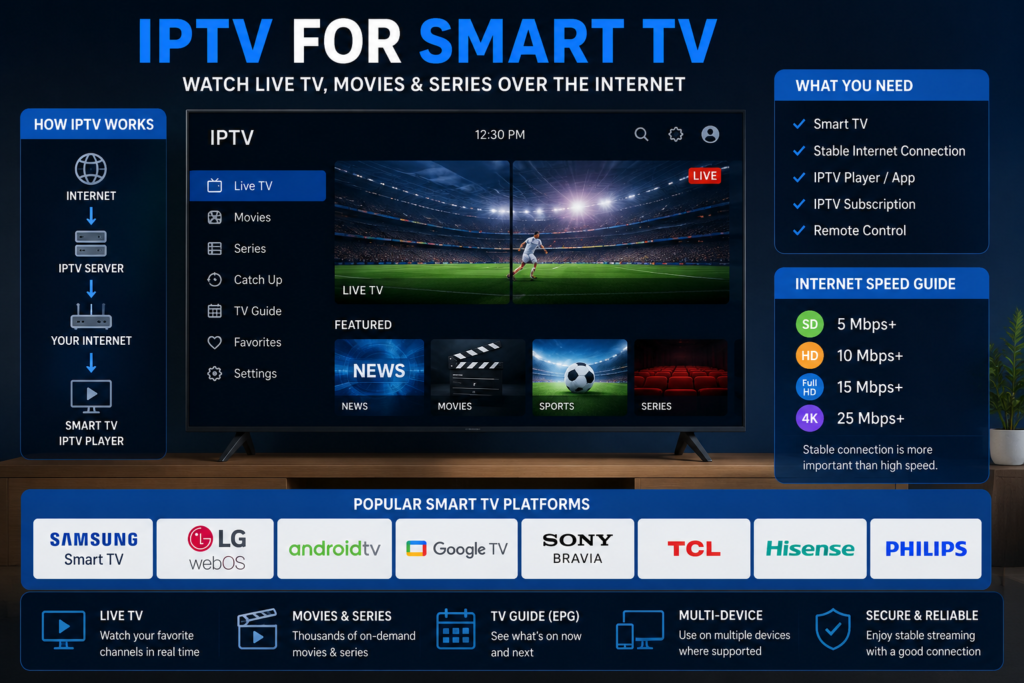
IPTV for Smart TV: Complete Setup Guide 2026
IPTV for Smart TV is a convenient way to watch internet-delivered television and video content directly on a compatible television. Instead of depending only on traditional cable or satellite television, IPTV uses an internet connection to deliver streaming content to your TV.
This guide explains how IPTV works on Smart TVs, what you need before getting started, how to install a compatible IPTV player, and how to troubleshoot common problems such as buffering, loading, and playback issues.
Important: IPTV is a technology for delivering video over an internet connection. Always use IPTV services and content that you are authorized to access.
What Is IPTV on a Smart TV?
IPTV stands for Internet Protocol Television. It delivers television and video content through an IP network, normally using an internet connection.
When using IPTV on a Smart TV, you generally install a compatible IPTV player or application on the television. The application then connects to your authorized IPTV account, playlist, or other supported source and displays the available content.
The exact setup depends on your Smart TV operating system, model, application, and IPTV service.
What Do You Need for IPTV on Smart TV?
Before setting up IPTV on your television, you normally need:
- A compatible Smart TV
- A reliable internet connection
- An IPTV-compatible application or player
- An authorized IPTV account, playlist, or connection information
- Your TV remote control
You do not normally need a traditional cable box when using an internet-based IPTV setup.
Which Smart TVs Support IPTV?
IPTV can be used on many modern Smart TV platforms, but application availability depends on the television manufacturer, operating system, model, and region.
Common Smart TV platforms include:
- Samsung Smart TV
- LG Smart TV
- Android TV
- Google TV
- Sony Smart TV
- Philips Smart TV
- TCL Smart TV
- Hisense Smart TV
Before installing an IPTV player, check the application store available on your specific television.
IPTV for Samsung Smart TV
Samsung Smart TVs use the Tizen operating system on many recent models.
A general setup process is:
- Connect your Samsung TV to the internet.
- Open the Samsung TV application store.
- Search for a compatible IPTV player.
- Install the application.
- Open the IPTV player.
- Enter the authorized account or playlist information provided by your IPTV service.
- Allow the application to load the available content.
- Select a channel or program to test playback.
The exact applications available can vary by TV model and country.
If an application is not available in your Samsung TV’s app store, do not assume that every Samsung TV supports it.
IPTV for LG Smart TV
LG Smart TVs use webOS on many current models.
To set up IPTV on an LG Smart TV:
- Connect the television to a stable internet connection.
- Open the LG Content Store.
- Search for a compatible IPTV player.
- Install the application.
- Launch the application.
- Enter your authorized IPTV account or playlist information.
- Wait for the content to load.
- Test several channels or videos.
If the application is unavailable, check whether your particular LG TV model and webOS version support it.
IPTV for Android TV
Android TV provides access to applications through Google Play Store.
The general setup process is:
- Connect Android TV to the internet.
- Open Google Play Store.
- Search for a compatible IPTV player.
- Install the application.
- Open the IPTV player.
- Enter your authorized IPTV connection details.
- Load the playlist or available content.
- Test playback.
For more information, see our IPTV for Android TV guide.
IPTV for Google TV
Google TV devices also support compatible applications through Google Play.
The basic process is similar to Android TV:
- Connect your Google TV device to the internet.
- Open the application store.
- Find a compatible IPTV player.
- Install the application.
- Configure your authorized IPTV account or playlist.
- Load the available content.
- Test playback.
Application availability may vary depending on the device and region.
What Internet Speed Do You Need for IPTV?
Your required internet speed depends on video resolution, compression, network usage, and the stability of your connection.
As a general guideline:
| Video Quality | Suggested Stable Speed |
|---|---|
| SD | 5 Mbps or more |
| HD | 10 Mbps or more |
| Full HD | 15 Mbps or more |
| 4K | 25 Mbps or more |
These are general guidelines rather than guarantees.
A stable connection is often more important than having a very high advertised download speed. Network congestion, Wi-Fi interference, router performance, and other devices using the connection can all affect streaming quality.
Wi-Fi vs Ethernet for Smart TV IPTV
Your Smart TV can usually connect to the internet through Wi-Fi or Ethernet.
Wi-Fi
Wi-Fi is convenient and easy to install.
Advantages include:
- No network cable required
- Easy installation
- Works well when the TV is close to the router
- Convenient for rooms where Ethernet is unavailable
However, Wi-Fi performance can be affected by distance, walls, interference, and other devices.
Ethernet
Ethernet connects the Smart TV directly to the router using a network cable.
Advantages include:
- More consistent connection
- Less wireless interference
- Good option for high-resolution streaming
- Often better for TVs located close to the router
If you experience frequent buffering over Wi-Fi, testing an Ethernet connection can help determine whether the wireless network is the problem.
How to Set Up IPTV on a Smart TV
The general IPTV setup process is straightforward.
Step 1: Connect Your Smart TV
Connect your television to your home internet using Wi-Fi or Ethernet.
Step 2: Open the App Store
Open the application store provided by your TV manufacturer or operating system.
Step 3: Find a Compatible IPTV Player
Search for an IPTV player that is compatible with your TV.
Always check the application’s compatibility with your exact TV model and operating system.
Step 4: Install the Application
Install the selected IPTV player and open it after installation.
Step 5: Enter Your IPTV Information
Depending on the service and application, you may need to enter information such as:
- Username
- Password
- Playlist URL
- Server information
- Other supported connection details
Only enter credentials and content sources that you are authorized to use.
Step 6: Load Your Content
After entering the required information, allow the application to load your available channels or video content.
Step 7: Test Playback
Select several channels or programs and check whether playback is stable.
If playback works on some channels but not others, the problem may be related to the specific stream rather than your television.
How to Improve IPTV Streaming on Smart TV
If your IPTV experience is not smooth, there are several things you can try.
Use Ethernet When Possible
A wired Ethernet connection can provide a more consistent connection than Wi-Fi.
Restart Your Router
Restarting your router can resolve temporary network problems.
Restart Your Smart TV
Turn the television off and restart it before testing playback again.
Check Your Internet Speed
Run an internet speed test from your network and compare the result with the requirements of the video quality you are watching.
Reduce Network Usage
If multiple devices are downloading large files, streaming video, or gaming simultaneously, your Smart TV may have less available bandwidth.
Keep Your TV Updated
Check for available firmware updates for your television.
Keep Your IPTV Player Updated
If the IPTV application provides an update, install it when appropriate.
IPTV Buffering on Smart TV
Buffering occurs when the device cannot receive enough video data quickly enough to maintain continuous playback.
Common causes include:
- Weak Wi-Fi signal
- Network congestion
- Unstable internet
- Router problems
- Device performance
- Application problems
- High-resolution streams
- Temporary service-side problems
If you experience buffering, start with basic network troubleshooting before changing multiple settings.
For more detailed information, see our IPTV Buffering Fix guide.
Common IPTV Problems on Smart TV
IPTV Channels Keep Loading
If channels continuously show a loading screen:
- Check your internet connection.
- Restart the Smart TV.
- Restart the router.
- Check your IPTV application.
- Test another channel.
- Check whether the problem affects all content.
IPTV Login Is Not Working
Check that your username, password, playlist URL, or other connection information has been entered correctly.
Also check whether your account is active and whether the information has expired.
IPTV App Is Not Available
Not every IPTV application is available on every Smart TV platform.
Check your TV’s application store and verify compatibility with your model and operating system.
IPTV Has Sound but No Picture
Try:
- Restarting the application
- Restarting the TV
- Testing another channel
- Updating the application
- Checking whether the problem affects one stream or all streams
IPTV App Keeps Crashing
Make sure the application and TV firmware are updated.
You can also restart the TV and check whether other applications work normally.
EPG Is Not Loading
Electronic Program Guide information depends on the IPTV service and the application.
Check your playlist or account configuration and make sure the EPG information provided by the service is correct.
IPTV vs Traditional Cable TV
IPTV and traditional cable television use different delivery methods.
| Feature | IPTV | Cable TV |
|---|---|---|
| Delivery | Internet connection | Cable network |
| Internet required | Yes | Usually no |
| Device flexibility | Often high | Depends on provider |
| Smart TV compatibility | Depends on app/platform | Depends on provider |
| Mobility | Possible on supported devices | Usually more limited |
| Performance | Depends on internet/network | Depends on cable infrastructure |
The best option depends on your location, internet connection, available services, devices, and viewing requirements.
For a detailed comparison, see IPTV vs Cable TV.
Is IPTV Legal?
IPTV is a technology used to deliver video content over an IP network. The legality of an IPTV service depends on the content it distributes and whether the provider has the necessary rights or permissions.
Using IPTV technology itself does not automatically determine whether a particular service is legal.
Always choose services and content that you are authorized to access.
Can You Use IPTV Without a Cable Box?
Yes. An internet-based IPTV setup does not normally require a traditional cable box.
A compatible Smart TV, internet connection, and supported IPTV application may be sufficient, depending on the service you use.
Can IPTV Work in 4K?
IPTV can support high-resolution video, including 4K, when the service, stream, application, television, and internet connection all support the required quality.
For reliable 4K streaming, a stable high-speed connection is important.
How Many Devices Can Use IPTV?
The number of devices that can use an IPTV account depends on the terms and limitations of the service.
Some services may allow multiple supported devices, while others may limit simultaneous connections.
Always check the conditions of your specific service.
Frequently Asked Questions
Can I use IPTV on any Smart TV?
Not necessarily. Compatibility depends on the television’s operating system, model, application availability, and the IPTV player’s requirements.
Does IPTV work on Samsung Smart TV?
Compatible IPTV applications can be used on supported Samsung Smart TV models. Application availability can vary by model and region.
Does IPTV work on LG Smart TV?
Yes, compatible IPTV players can be available for supported LG Smart TVs. Check the LG Content Store and your TV’s webOS version.
Does IPTV require internet?
Yes. IPTV relies on an IP network to deliver streaming content, so a reliable internet connection is required for internet-based IPTV.
Is Ethernet better than Wi-Fi for IPTV?
Ethernet can provide a more stable connection and may be preferable for high-resolution streaming or situations where Wi-Fi is unreliable.
Why does IPTV buffer on my Smart TV?
Buffering can be caused by unstable internet, weak Wi-Fi, network congestion, device limitations, application problems, high video quality, or temporary service issues.
Can I use IPTV on Android TV?
Yes. Compatible IPTV players can be installed on supported Android TV devices through available application stores.
Can IPTV replace cable TV?
For some viewers, IPTV can be an alternative to traditional television delivery. The suitability depends on the available services, internet connection, and content you want to watch.
What should I do if IPTV stops working?
First check your internet connection, restart your router and Smart TV, restart the IPTV application, and test another channel or stream.
For additional solutions, visit our IPTV Troubleshooting guide.
More IPTV Guides
Continue learning with our other IPTV resources:
- IPTV Guide – Complete beginner’s guide to IPTV
- IPTV for Firestick – Learn how IPTV works on Fire TV devices
- IPTV for Android – IPTV setup information for Android devices
- IPTV for iPhone – IPTV information for iPhone and iPad
- IPTV for Android TV – Android TV setup guide
- IPTV Troubleshooting – Solutions for common IPTV problems
- IPTV Buffering Fix – Ways to reduce buffering
- IPTV Setup Guide – General IPTV setup instructions
- IPTV FAQ – Answers to common IPTV questions
Final Thoughts
Using IPTV for Smart TV can provide a flexible way to access internet-delivered television and video content without relying entirely on traditional cable infrastructure.
The most important factors for a good streaming experience are a compatible television, reliable internet connection, suitable IPTV player, and an authorized IPTV service.
If you are just getting started, begin with our IPTV Guide and then follow the device-specific instructions for your Smart TV.